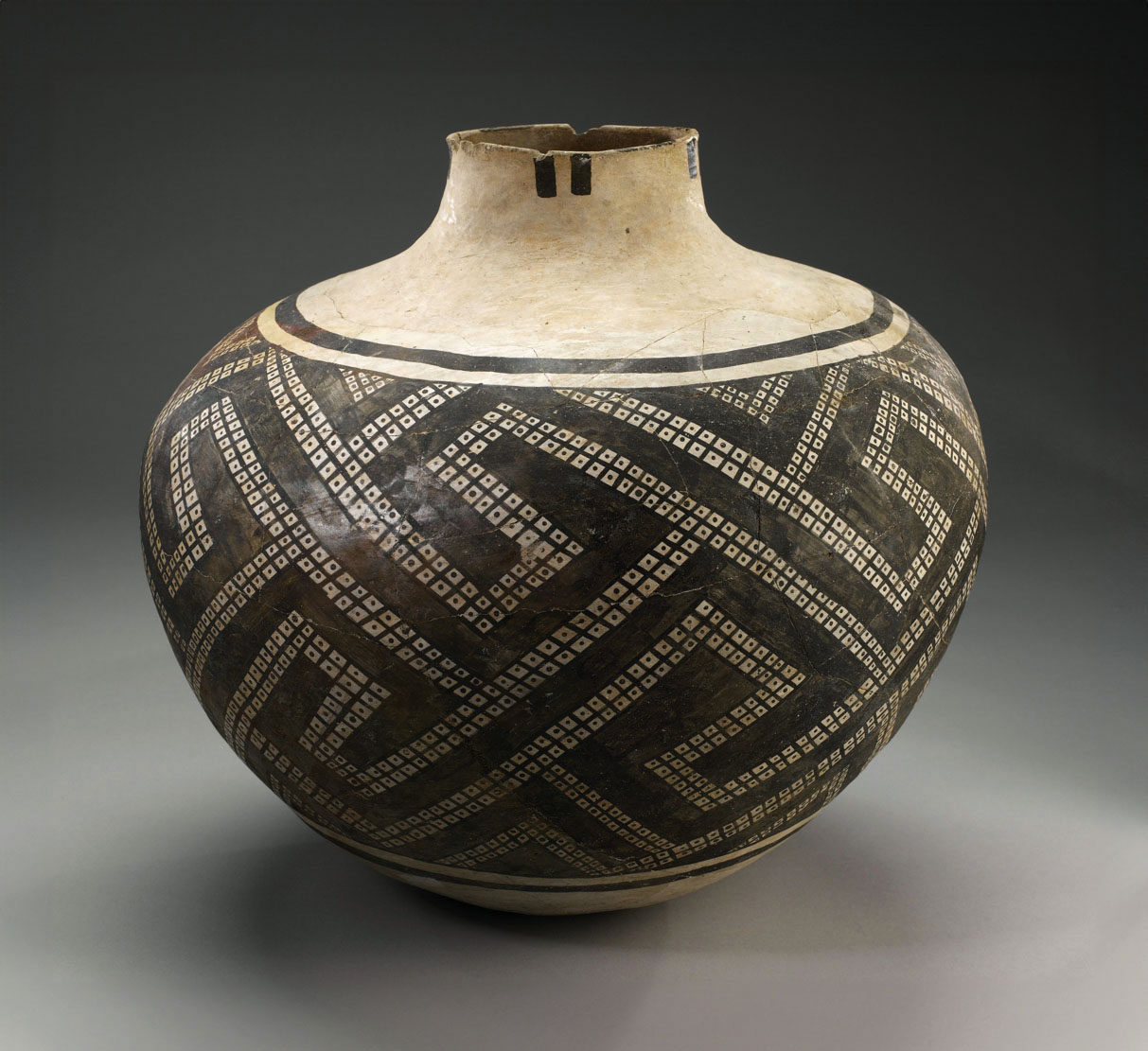
 Ancestral Pueblo, Pot (Olla), 13th-14th century, clay, pigments, 14½ x 15¾”. Minneapolis Institute of Art, Minneapolis, MN. Gift of the Putnam Dana McMillan Fund.
Olla
Simple pueblo pottery from before the eighth century has been found in the Rio Grande Valley. Large storage jars called olla were made to hold food and water. The clay vessels were mostly undecorated but sometimes textured. The pottery used for ceremonies was often richly decorated with black painted designs. The arrival of the Spanish in the 16th century brought changes to the style and use of pueblo pottery. They began to make dough bowls when the Spanish introduced them to wheat and yeast. Previously they had made unleavened corn tortillas.
Decoration referenced the natural environment often with geometric symbols representing clouds, rain, animals and plant life. The Minneapolis Institute of Art comments on a 13th- to 14th-century Ancestral Puebloan pot in its collection: “The full, round shape of this olla is emphasized by the decorative pattern of black and white painted onto the surface. The interlocked lines of small white squares with a dot in the middle represent a traditional three-step cloud motif and also refer to lightning, which heralds the summer rainstorms. The square and dot design evokes rows of maize kernels, a staple food source for the Ancient Puebloans.”
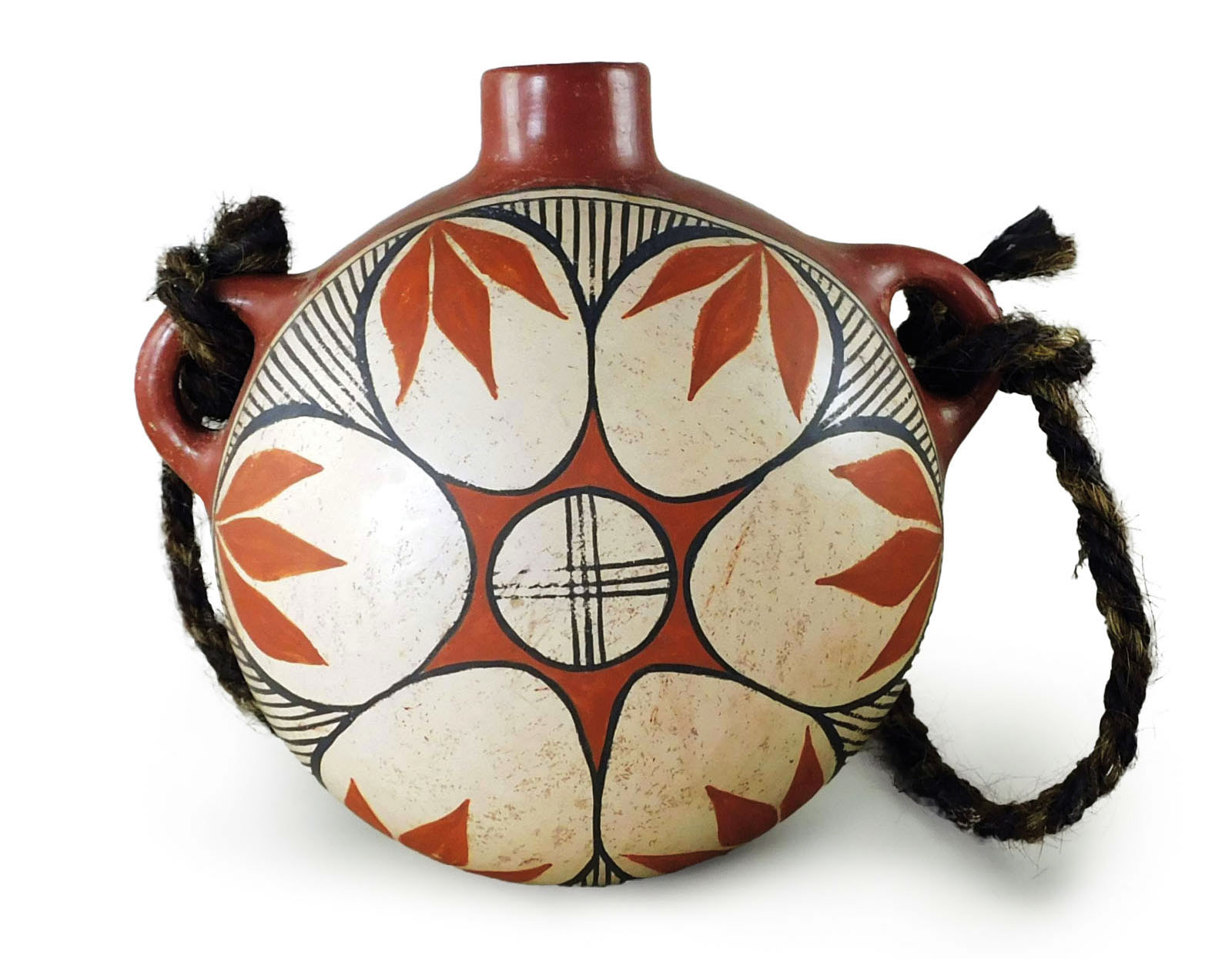 Zia, Canteen, ca. 1930, clay, fiber cord, 10 x 10”. Courtesy Lyn A. Fox Fine Pueblo Pottery, Santa Fe, NM.
Canteen
A large 10-by-10-inch canteen was made at Zia Pueblo to hold a large amount of water. Zia canteens from the 1930s were usually made for daily use.
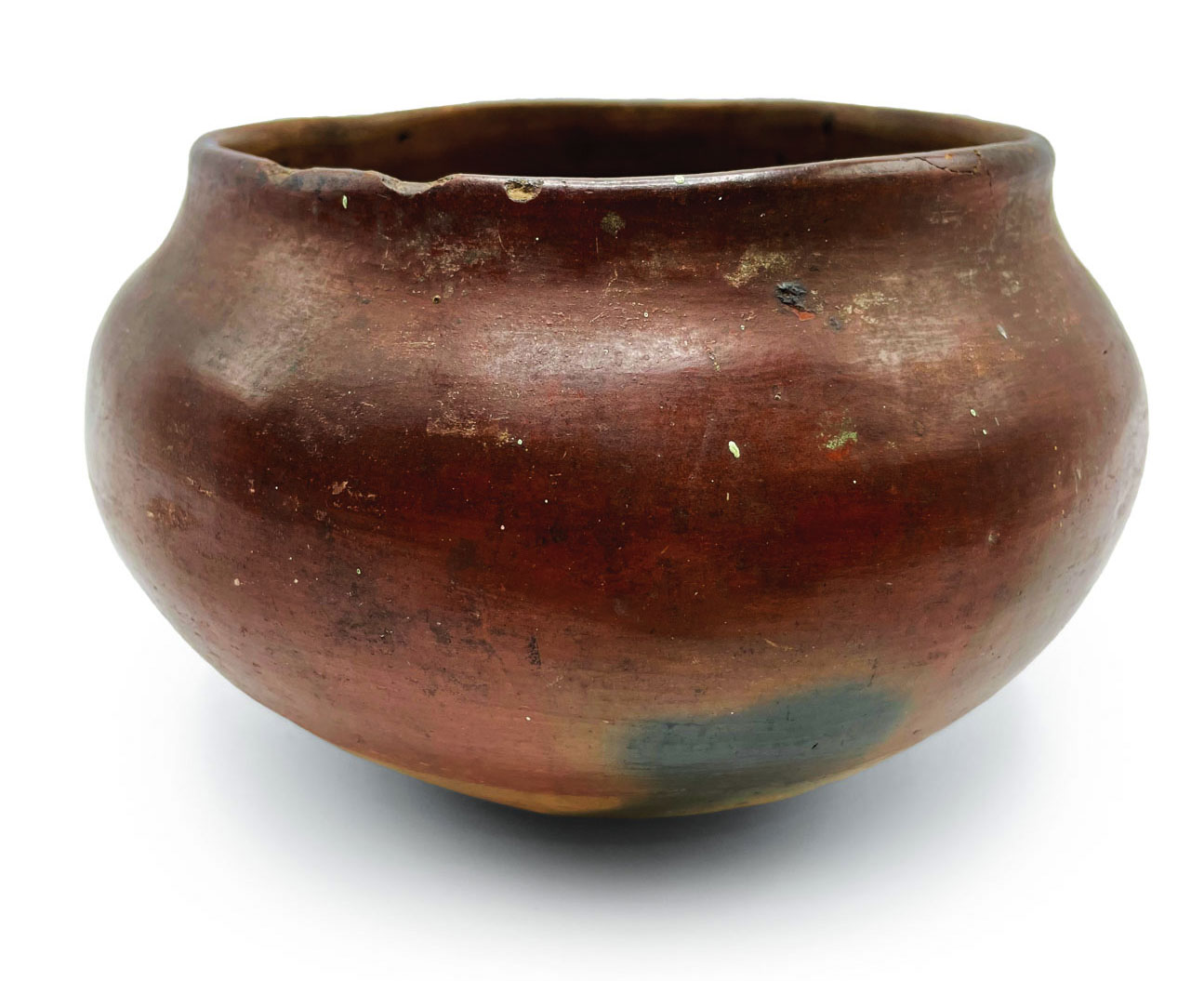 Ohkay Owingeh/San Juan, Large Red/Tan Dough Bowl, ca. 1880s. Courtesy Lyn Fox A. Fine Pueblo Pottery, Santa Fe, NM.
Dough Bowl
A large Ohkay Owengeh/San Juan Dough bowl has black fire clouds on the stone-polished exterior caused by smoke or fire burning too close to or touching the pot during its traditional outdoor firing.
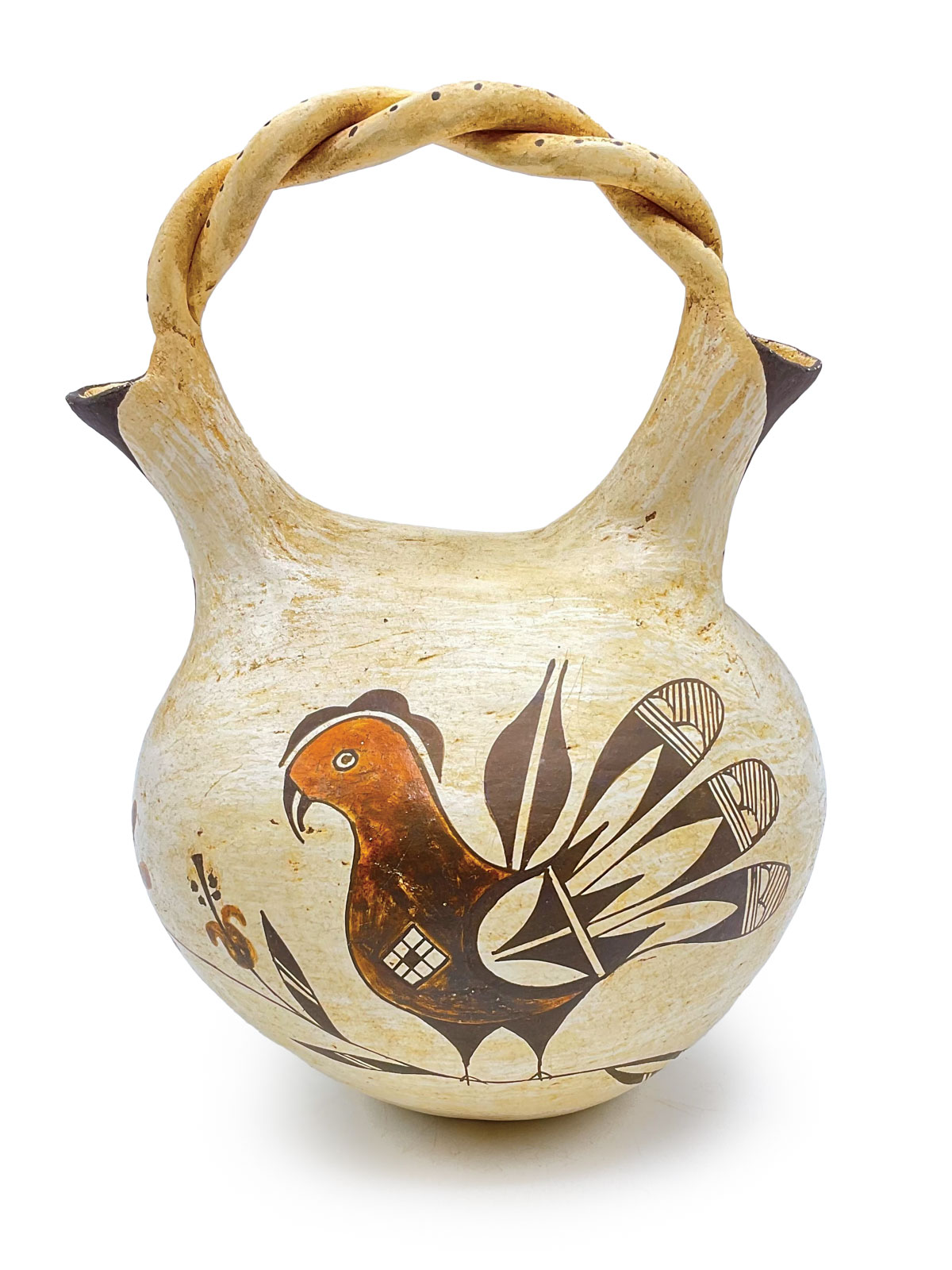 Acoma, Wedding Vase, ca. 1920, clay, pigments. Courtesy Lyn A. Fox Fine Pueblo Pottery, Santa Fe, NM.
Wedding Vase
Pueblo wedding vases were made by the groom’s parents for use in the wedding ceremony. The bride and the groom drink water or a nectar prepared by a medicine man from one of the two spouts. The two spouts joined in one vessel signifies the couple becoming one in marriage as does the handle at the top. The resulting space between the handle and the body of the vase represents the circle of life.
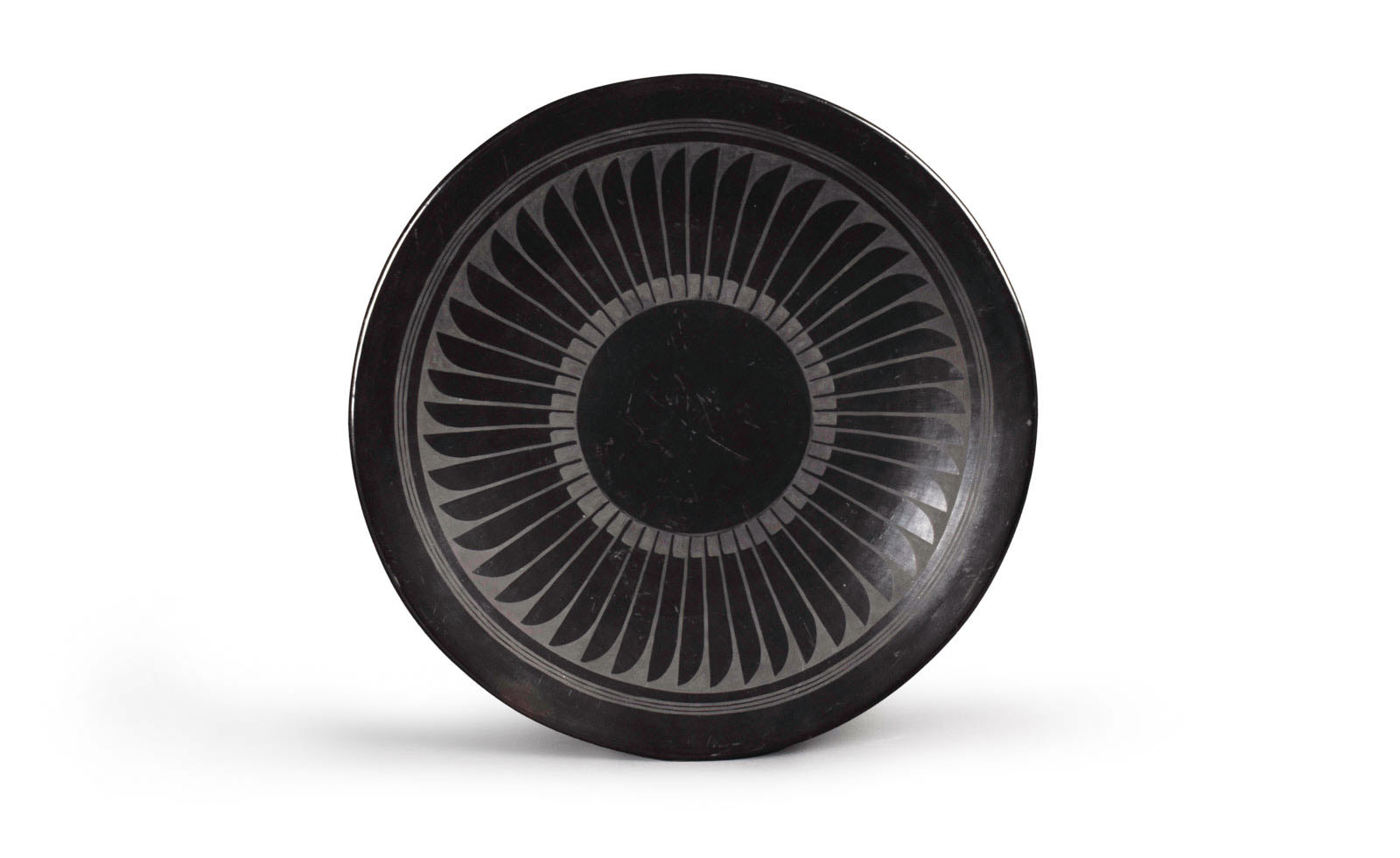 Maria Martinez (San Ildefonso, 1887-1980), Santana Martinez (San Ildefonso, 1909-2002), Plate, clay, 14¾ x 15/8”. Courtesy Adobe Gallery, Santa Fe, NM.
Plate
Maria Martinez (San Ildefonso, 1887-1980) and her husband Julian (San Ildefonso, 1879-1943) developed black-on-black pottery from sherds of ancient pottery. Working with her daughter-in-law, Santana, (San Ildefonso, 1909-2002), Maria produced a large plate with a feather design that Julian had adapted from a Mimbres pottery motif.
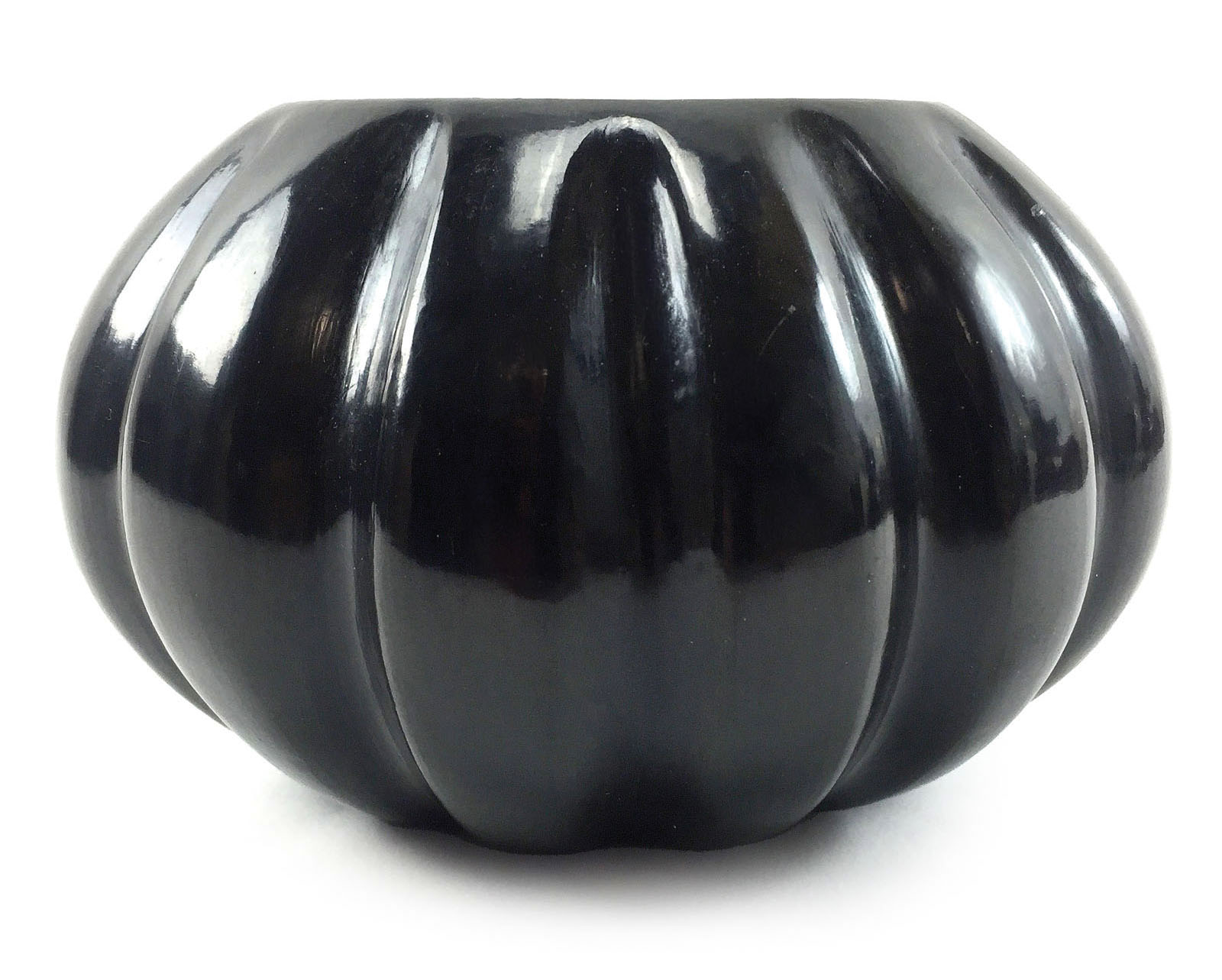 Helen Shupla (Santa Clara, 1928-1985), Black Melon Jar, ca. 1980s, clay, 4 x 6½”. Courtesy Mark Sublette Medicine Man Gallery, Tucson, AZ.
Melon Jar
Design motifs relating to the seasons and plant life evolved into pottery emulating the plant life itself. Helen Shupla (Santa Clara, 1928-1985) “was known for her magnificent melon jars,” according to Mark Sublette of Medicine Man Gallery in Tucson, Arizona. “Helen was unique in her method of creating the melon style in that she would push the ribs out from the inside while the clay was still pliable. This process required patience and care, as it is easy to poke an irreparable hole in the clay.”
Contemporary artists continue to produce traditional shapes and designs with innovations from other cultures as well as their own creative imaginations and skill.
Descendants of the Santa Clara matriarch Margaret Tafoya (1904-2001), continue her tradition of incising the melon jar ribs into clay that has dried to a leather hardness. Their skill in carving results in pots with over 30 fine ribs.
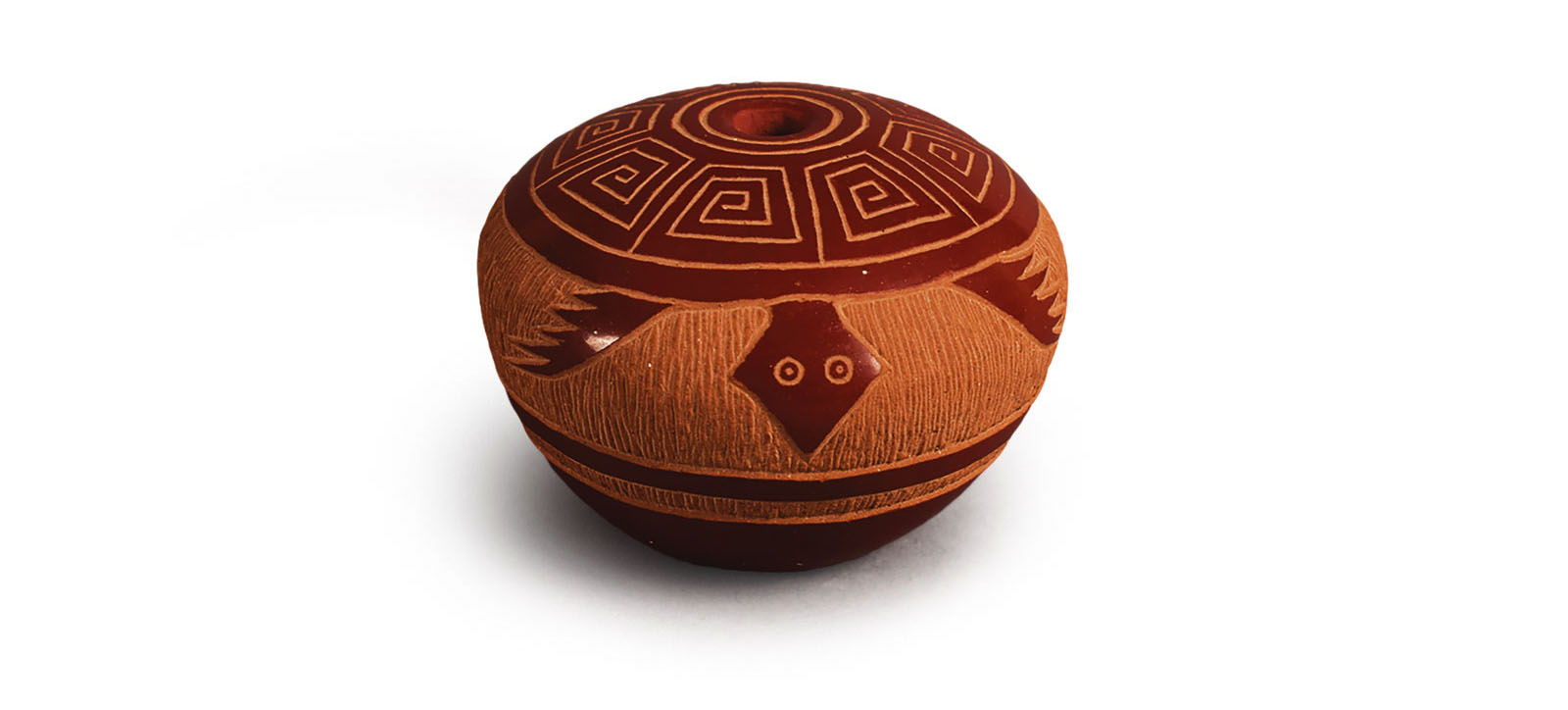 Joseph Lonewolf (Santa Clara, 1932-2014), Miniature Seed Pot with Turtle Design clay, 1¼ x 1¾”. Courtesy Adobe Gallery, Santa Fe, NM.
Seed Pot
The circle of life is also referenced in seed pots. Seeds are stored by putting them into the pot, one at a time, through a small opening in the top. If seeds were stored in traditional pots with large openings, they could be eaten by rodents and insects. The sherds found at ancient sites are often from seed pots shattered to release the seeds in the spring. Joseph Lonewolf (Santa Clara, 1932-2014) decorated his Miniature Seed Pot with a turtle design. The turtle appears in different tribal creation stories and also represents healing, wisdom, spirituality, health, safety, longevity, protection and fertility.
Lonewolf often used design motifs from Mimbres pottery. He explained, “There is really nothing new in what I do. I simply re-discovered some of the secrets known to my ancestors—the Mimbres people—nine or 10 centuries ago... And I believe that those old ones are my guides and mentors still, showing me in my dreams and visions how to use the old Mimbres designs in new ways, just as they direct my hands and heart when I work those invisioned [sic] symbols into my pots.” The Classic Mimbres period occurred in southwestern New Mexico between 1000 and 1300.
Powered by Froala Editor


